


The Price of Pretty: Redefining Durability and Sustainability in Healthcare Design
Design always needs to be a balance of form and function. In recent decades, the scale tipped heavily toward form, as healthcare designers faced intense pressure to create warm, hotel-like environments on constricted construction budgets. In response, some design teams decided to specify fabrics and coatings that were never meant for demanding healthcare settings.
The results were disastrous.
“I specified the best I could, but they still were failing,” recalls Barbara Dellinger, MA, FIIDA, CHID, a healthcare interior designer and Principal of Dellinger Consulting LLC with 35 years of experience leading evidence-based specification for major hospital networks and military facilities.
The turning point occurred on a shuttle bus at the 2017 Design Connections conference. A group of frustrated healthcare interior designers (including Dellinger) and facility experts realized they were all dealing with the same pain point: their non-vinyl specifications were prematurely failing in hospitals across the country.
“We just all had this ‘aha moment’ at that time,” Dellinger says. That realization led directly to the formation of what ultimately became the Durable Coated Finishes Task Group (DCF+), a coalition of healthcare designers, manufacturers, and industry experts working collaboratively to address the widespread breakdown of upholstery currently occurring in healthcare settings across North America.
Nearly 10 years since the formation of this group, they’ve made many strides in communicating the performance and sustainability of vinyl, but there are still many challenges and misconceptions within the healthcare design space that need to be overcome.
Real-World Conditions vs. Aesthetic Intent
A major misconception in the design community is that healthcare facilities can seamlessly borrow trends from the hospitality industry to create a warmer, more welcoming environment compared to the cold, institutional feel often associated with hospitals. While a hospitality aesthetic is comforting in theory, it ignores the reality of clinical spaces. A hospital is not a boutique hotel; it is an active medical environment subjected to 24/7 use, heavy rolling equipment, bodily fluids, and relentless scrubbing.
When non-vinyl residential or hospitality materials are specified to soften an institutional space, they often prove entirely unsuitable. Jane Rohde, AIA, FIIDA, ASID, CHID, a healthcare designer with 30 years of sustainability experience and Principal and Founder of JSR Associates, Inc., points directly to a systemic gap in professional education as the root cause.
“The younger designers are focused on aesthetics,” Rohde notes. “At the collegiate level, they are focused on technology, such as AutoCAD, balanced with design principles but often are not taught material science courses.”
Many alternatives to vinyl fail in two distinct ways under healthcare conditions: they are either physically fragile or biologically absorbent. Some coatings lack the structural strength to survive, cracking and peeling within months under aggressive chemical disinfection. Other choices, like wool, cotton or linen, are highly porous. In environments dealing with bodily fluids and biohazards, absorbent fabrics trap liquid deep inside, making them impossible to sanitize and create a pathogenic reservoir as a hazard.
And cleaning protocols have only gotten more stringent since COVID-19, which challenges the structural limits of materials like never before. Shari Solomon, a highly trained expert providing infection prevention, industrial hygiene training and consulting services as President of CleanHealth Environmental, LLC, emphasizes that these demands will only continue to increase, and specifying for real-world demands in addition to aesthetics is critical.
“Surface contamination is a transmission point,” Solomon notes. “With the issue of multi-drug-resistant organisms, where we have different types of microorganisms that are mutating … cleaning and disinfection is going to be more important. We’re going to be using perhaps harsher chemicals.”
While creating warm, welcoming healthcare environments remains an important design objective, DCF+ members emphasize that healing environments must first support clinical care. Material selections should enhance the patient experience without compromising infection prevention, durability, or long-term performance.
Healthcare Demands Proven Performance
To prevent premature degradation, designers should look to verified performance benchmarks rather than baseline industry minimums that may not reflect real-world healthcare conditions. The Coated Fabrics and Film Association (CFFA) Performance Products Division provides this essential guidance through its CFFA-Healthcare-201 certification program, evaluating coated fabrics against 16 distinct clinical performance metrics.
It is important to recognize that not all vinyl products perform equally. For example, products that meet the CFFA Healthcare 201 Certification, as a minimum performance standard, and that are manufactured by +Vantage Vinyl™ verified companies, are those that combine proven healthcare performance with a manufacturer’s demonstrated commitment to responsible operations and continuous sustainability improvement.
Feedback from members of the DCF+ emphasizes that higher-quality vinyl formulations with lower filler content can provide greater chemical and scratch resistance while being better suited for integral cove base applications without cracking or fissuring. These characteristics help support long-term cleanability and infection prevention best practices.
In short, modern vinyl bridges the gap by delivering the aesthetics designers want with high-performance surfaces engineered to help maintain the protective barrier between patients and pathogens.
Upfront Cost Versus Life Cycle Costing Is the Enemy
The material performance gap is worsened by institutional silos. In most hospital systems, initial capital construction funds are kept separate from yearly operational and maintenance budgets. Institutions frequently default to the lowest upfront cost and simply hope the material lasts versus taking a life cycle cost approach that can reduce premature replacements.
“Things always come back to cost,” explains Dellinger. “Even though you do ROI analysis and you show that you get what you pay for, I’ve seen projects, even recently, where they don’t have the money upfront … so they’re going to go with the lowest option and just hope that it lasts.”
To break this cycle, healthcare executives must transition from a simple upfront cost mindset to a rigorous Life Cycle Cost Analysis (LCCA). Unlike an environmental Life Cycle Assessment (LCA), which evaluates ecological footprints, an LCCA calculates the total cost of ownership over a product’s operational lifespan. This analysis shifts the focus from the initial construction invoice to long-term performance, factoring in product durability, replacement costs, and the intense demands of infection prevention.
When viewed through a strict LCCA lens, vinyl consistently emerges as one of the most economically sustainable choices. Because it is engineered to withstand aggressive cleaning cycles without disintegrating, a single vinyl installation is more likely than many other materials to avoid the costly cycle of premature breakdown and emergency replacement, ultimately protecting patients and the hospital’s bottom line.
DCF+ members also point to additional lifecycle advantages that are often overlooked. Some vinyl flooring products can be restored through dry buffing, extending their useful life without replacement, while many can also be recycled back into new flooring at the end of their service life. Together, these attributes strengthen the case for specifying durable vinyl flooring.
Healthcare Environmental Services Should Be a Key Stakeholder
Another major disconnect occurs between the construction/design teams and frontline healthcare Environmental Services (EVS) staff. Too often, interior finishes are specified without ever consulting the people responsible for cleaning and maintaining them.
DCF+ discussions have also highlighted situations where sustainability policies or specification preferences unintentionally limit consideration of materials that best support durability, infection prevention, maintenance, and lifecycle cost. These experiences reinforce the importance of evaluating products based on current performance evidence alongside other goals.
“The reality is that they’re using harsh disinfectants on what is intended to be for hard, non-porous surfaces,” Solomon explains. When these aggressive chemicals are applied to the wrong materials, the surfaces inevitably break down. These breaches turn surfaces into dangerous reservoirs for bacteria.
Because EVS is rarely brought to the design table, materials are frequently selected without knowing about the cleaning and disinfecting products or the equipment and tools the facility uses. Designers often specify materials assuming they will be cleaned gently, but increased infection prevention mandates cleaning teams use aggressive chemicals. The materials are also likely cleaned much more frequently and vigorously than they would in a hotel setting.
Feedback shared through the DCF+ also highlights that healthcare end users consistently prioritize durability first, followed by the ability to keep flooring clean and looking good without excessive maintenance. With EVS departments facing ongoing staffing and budget constraints, upholstery and flooring must perform within the realities of limited time and resources rather than requiring specialized cleaning methods or intensive upkeep.
Institutional silos inhibit any current product issues from being communicated with design teams.
Rohde recalled a flooring specification that did not take deep cleaning into consideration. “The flooring was white with an ingrained indentation embossed on the surface,” she explained. “The EVS manager had to sit on the buffer so that when the machine went across the floor, it could get down into the crevices to clean it.”
Examples like this prove that increased communication between design teams and frontline EVS technicians is critical. Those who utilize and maintain these products daily can provide key insights and a better understanding of operational needs to help designers offer smarter material specifications.
Redefining the Narrative: Durability Is Sustainability
Members of the DCF+ note that many misperceptions about vinyl in healthcare are rooted in products and performance data from decades ago rather than using current data. Modern vinyl products have advanced significantly in durability, cleanability, formulations, and environmental sustainability, making it important to evaluate current products using current evidence rather than outdated assumptions.
When a facility specifies a vinyl alternative based on inaccurate assumptions, it often increases its environmental footprint.

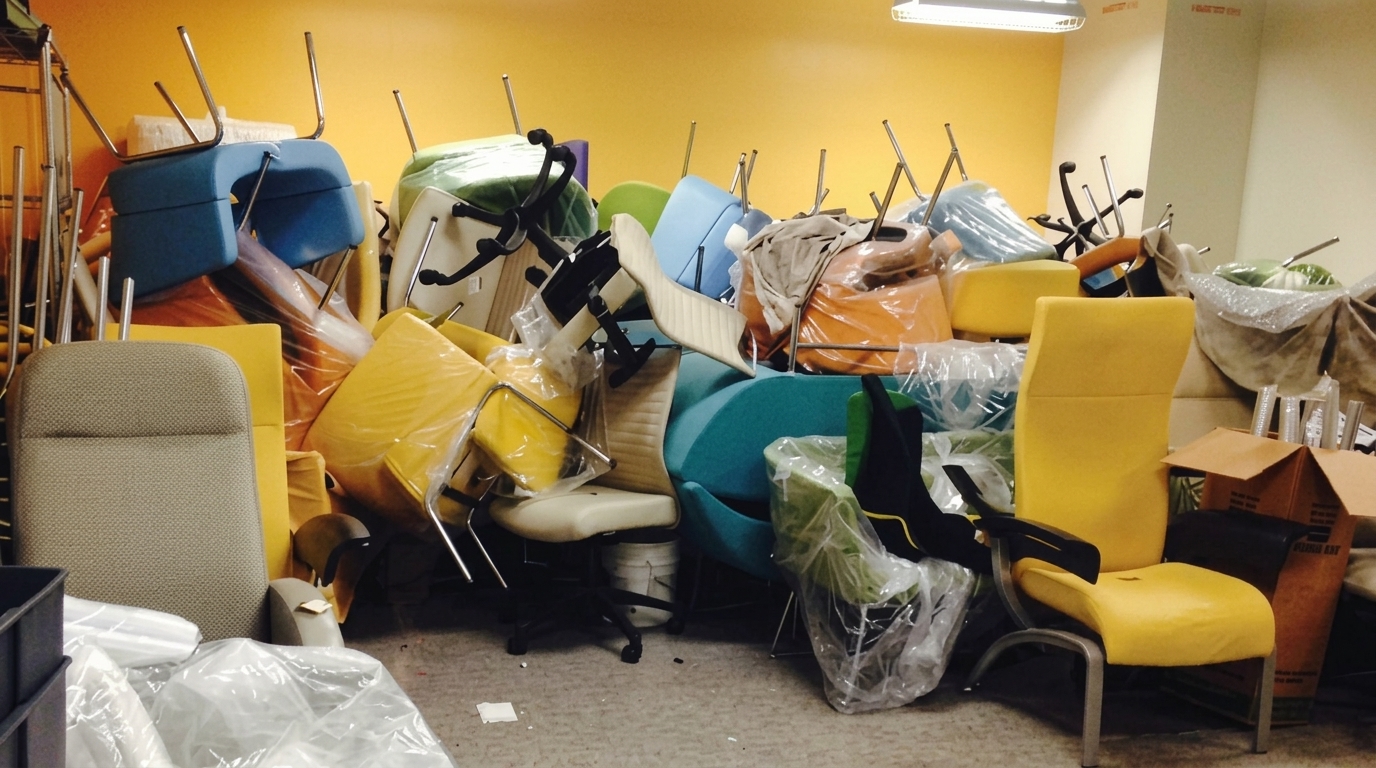
Replacing cracked chairs and floors or repeatedly renovating due to premature failures, that are less likely when vinyl is specified, creates more waste and landfill volume. As Rohde points out, many alternative upholstery products carry a larger environmental footprint and lower durability threshold than vinyl yet are often specified based on a flawed understanding of the materials, their formulations, and their life cycle assessment.
Upholstery products that meet the CFFA Healthcare 201 Certification and are manufactured by +Vantage Vinyl™ verified companies support both performance and sustainability goals. These are examples of high-performing products from manufacturers committed to responsible operations and continuous improvement. Ultimately, a product’s service life is its most critical environmental attribute. Modern vinyl is sustainable precisely because it is durable, keeping products out of the graveyard longer and proving that longevity is the ultimate form of sustainability.
The same commitment to verified performance and sustainability extends beyond product testing. CFFA is also helping advance circularity across the vinyl industry through its leadership in vinyl recycling with support from the Vinyl Sustainability Council’s (VSC) VIABILITY grant program.
A Science-Based Future for Healthcare Design
Designing a successful healthcare space requires breaking out of institutional silos and looking at the complete, long-term life cycle of a facility. Upfront capital savings mean nothing if a material disintegrates under daily clinical realities, creates potential bacterial reservoirs, challenges cleaning teams, or ends up in a landfill prematurely.
The healthcare industry must shift from aesthetically driven design specifications to science-based, life cycle-driven specifications. This requires bringing operations, infection prevention, and environmental services to the table during the earliest planning phases.
Modern vinyl effectively bridges the historical gap between form and function. It delivers the pleasing aesthetics today’s designers want, backed by the resilience that clinical spaces demand. By keeping the protective barrier between patients and pathogens intact for the long haul, vinyl provides a durable solution in healthcare infrastructure, and durability isn’t just a performance metric — it is the ultimate form of sustainability and patient safety.
View VSC members driving innovation and sustainability in the vinyl industry.
Questions about the VSC or +Vantage Vinyl™? Contact us today.